Published: October 21, 2026
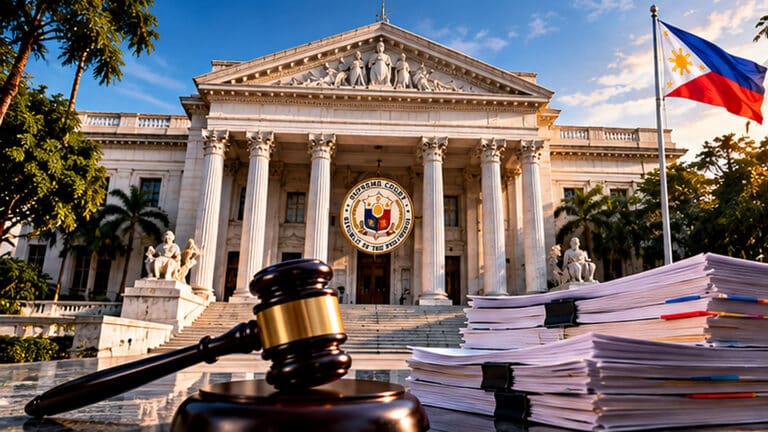
The Philippine Supreme Court has declared the country’s 2024 and 2025 General Appropriations Acts (GAAs) unconstitutional and struck down specific provisions of the 2026 national budget.
The decision, written by Senior Associate Justice Marvic M.V.F. Leonen and publicly announced on October 20, 2026, addresses congressional increases in government spending, the use of unprogrammed appropriations, and constitutional limits on the national budget.
The ruling does not mean that every completed government project must be reversed or that every official involved has been found personally liable.
It does, however, establish important restrictions on how Congress approves public spending and how the Executive may use certain standby funds.
The Marcos administration has announced plans to request reconsideration of parts of the decision.
Why Were the 2024 and 2025 Philippine Budgets Declared Unconstitutional?
The Supreme Court identified separate constitutional problems in the two budgets.
The 2024 budget: A ₱449.5 billion increase
Under Republic Act No. 11975, Congress increased unprogrammed appropriations by approximately ₱449.5 billion beyond the President’s proposed amount.
The unprogrammed-appropriations allocation rose from about ₱281.9 billion in the National Expenditure Program to ₱731.4 billion in the enacted budget.
The Court found that the increase violated Article VI, Section 25(1) of the Constitution, which prohibits Congress from increasing the total appropriations recommended by the President.
The Court’s interpretation means that the constitutional spending ceiling cannot be avoided simply by categorizing additional expenditures as unprogrammed.
The 2025 budget: The Special Road Fund
The Supreme Court also declared Republic Act No. 12116, the 2025 GAA, unconstitutional.
Its findings included an approximately ₱17.99 billion congressional increase in the Department of Public Works and Highways’ Special Road Fund.
The Court determined that the increase exceeded the President’s recommended appropriations and was inconsistent with applicable budget restrictions.
It also found that a ₱12.75 billion increase in certain Special Accounts in the General Fund violated restrictions under the Administrative Code.
These findings address the legal structure and approval of appropriations. They do not, by themselves, establish that the entire amounts were disbursed, misappropriated, or stolen.
What Did the Supreme Court Decide About the 2026 Budget?
The Court invalidated Special Provisions 1(a) and 1(b), Chapter XLIII, of the 2026 General Appropriations Act.
The provisions governed conditions for releasing unprogrammed appropriations.
The Court determined that the provisions provided insufficient safeguards and allowed funding decisions that were inconsistent with constitutional requirements.
It emphasized that unprogrammed appropriations are not inherently unconstitutional.
However, their use must remain consistent with the national fiscal program and must have clear standards, limitations, and lawful funding conditions.
The Court permanently prohibited specified government institutions from implementing the invalidated 2026 provisions.
The distinction matters: The ruling did not declare the entire 2026 GAA unconstitutional.
What Are Unprogrammed Appropriations?
Unprogrammed appropriations are standby spending authorizations.
Unlike ordinary programmed spending, they are intended for use when applicable funding conditions are satisfied, such as the availability of qualifying additional revenues or approved financing.
For example, the government may identify a project that could receive supplementary funding if lawful funding conditions are subsequently met.
The problem arises when standby appropriations are used in ways that circumvent budget limits, permit insufficiently defined allocations, or give government officials excessive discretion over spending decisions.
The Supreme Court also found problems with Strengthening Assistance for Government Infrastructure and Social Programs, or SAGIP, which it regarded as an impermissible lump-sum mechanism.
The broader principle is that public spending must be authorized through constitutionally valid procedures—not merely justified by the government’s desire to fund a project.
What Did Former President Rodrigo Duterte Warn About?
The former president had previously questioned the validity of the 2025 national budget.
In January 2025, Duterte and then-Representative Isidro Ungab raised concerns about alleged blank entries and discrepancies in the bicameral conference committee report.
Duterte argued that a budget approved with material omissions could be legally defective.
President Ferdinand Marcos Jr. strongly disputed those allegations at the time, maintaining that the enacted GAA contained no blank appropriations.
The Supreme Court’s October 2026 ruling does not mean that every allegation about blank entries was judicially proven.
The Court’s publicly reported constitutional findings concerned unauthorized appropriation increases, the Special Road Fund, unprogrammed-fund safeguards, and related budgetary mechanisms.
The earlier warnings are relevant to the history of scrutiny surrounding the national budget, but they should not be confused with the specific findings of the judgment.
What Did Vice President Sara Duterte Say?
Vice President Sara Duterte welcomed the Supreme Court ruling on October 21, 2026.
She called for President Marcos and members of Congress to be held accountable for their roles in approving the challenged budgets.
The Vice President had also raised concerns about how the national budget was handled, including the influence of congressional leaders and the bicameral conference committee.
Her latest statement argues that public officials should answer for approving spending measures that failed constitutional scrutiny.
Those are the Vice President’s political and legal assertions. The Court’s decision does not automatically establish personal criminal liability against the individuals she named.
How Did the Marcos Administration Respond?
Malacañang announced on October 21 that it would ask the Supreme Court to reconsider parts of its ruling.
Palace Press Officer Claire Castro said the administration respectfully disagreed with certain conditions the Court imposed on the use of unprogrammed appropriations.
According to the Palace, the Marcos administration followed budget procedures that had been used for years, and the government considers unprogrammed appropriations a lawful funding mechanism when properly implemented.
The Office of the Solicitor General was directed to seek reconsideration.
As of October 21, the announced reconsideration effort does not mean that the Court has changed or reversed its decision.
Does the Ruling Cancel Government Projects and Spending Already Completed?
Not automatically.
The Supreme Court applied the doctrine of operative fact to qualifying consequences of the 2024 and 2025 budget laws.
The doctrine recognizes that some actions carried out under a law before it is declared unconstitutional cannot simply be undone.
Under the Court’s ruling, certain irreversible programs and projects involving beneficiaries who acted in good faith may retain their legal effects.
However, this protection is not blanket immunity for public officials responsible for authoring, proposing, or implementing unconstitutional provisions.
Questions about their possible civil, criminal, or administrative responsibility would require appropriate proceedings.
The decision therefore separates protection for qualifying beneficiaries from possible accountability for officials.
What Happens Next?
Three developments deserve attention.
First, the Office of the Solicitor General may pursue the announced reconsideration request.
Second, budget officials and lawmakers will need to consider how the decision affects the implementation of relevant provisions and the preparation of future budgets.
Third, any investigation into specific spending irregularities must distinguish documented misuse of public money from constitutional defects in the appropriations process.
The publication of the decision’s complete text, relevant separate opinions, and subsequent Supreme Court orders will also be important for understanding its precise legal effects.
PHExpat Bottom Line
The Supreme Court’s ruling establishes constitutional limits on congressional increases in appropriations and on the conditions for using standby government funds.
The 2024 and 2025 GAAs were declared unconstitutional, while specific provisions of the 2026 budget were invalidated.
Some completed projects and good-faith beneficiaries may remain protected under the doctrine of operative fact.
Former President Rodrigo Duterte and Vice President Sara Duterte had raised objections to aspects of the budget process, but the Court’s findings must be distinguished from their broader allegations.
With the Marcos administration seeking reconsideration, the legal and practical consequences remain a developing story.
Sources
- Supreme Court — Consolidated GAA Cases and official case records
- 1987 Philippine Constitution — Official Gazette
- GMA News — Supreme Court announces ruling, October 20, 2026
- GMA News — Detailed account of the ruling, October 21, 2026
- GMA News — Rodrigo Duterte’s January 2025 objections
- Presidential Communications Office — Marcos responds, January 20, 2025
- GMA News — Sara Duterte’s October 21, 2026 statement
- Presidential Communications Office — Planned reconsideration, October 21, 2026
Editorial note: This article reports the Supreme Court’s publicly announced findings and attributed public statements. A ruling on the constitutionality of appropriations does not, without further findings, establish individual criminal guilt. This developing article should be updated after material court orders or other verified developments.