
Dear Ma,
There is a question I have been thinking about.
Why do so many Filipinos leave a country they love?
We grow up knowing the Philippines as home. It is where our families are, where our identities begin, and where so many of our hopes are first formed.
Yet, for countless Filipinos, building a better future means leaving that very place behind.
Sometimes, Ma, I wonder whether people understand how complicated that decision can be.
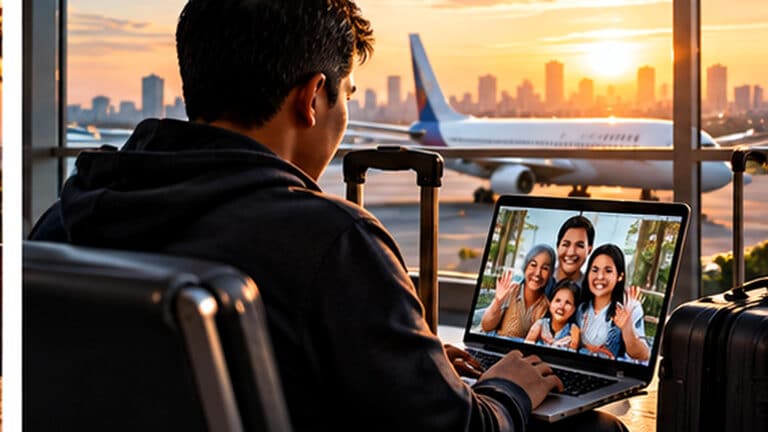
From the outside, leaving looks simple. Someone receives a job offer, buys a plane ticket, packs a suitcase, and begins a new chapter overseas.
But behind that departure may be years of trying, saving, hoping, and wondering whether life could offer something more.
And not every departure is a happy one.
When Love for Home Is Not Enough
Ma, I think one of the hardest things to explain is that loving your country does not necessarily mean you can build the life you want there.
A person can love the Philippines and still struggle to find a job that pays enough.
A parent can want to raise their children close to family and still accept employment thousands of miles away.
A young Filipino can dream of building a future at home but discover that the opportunities they seek are somewhere else.
Of course, not everyone leaves because of hardship. Some Filipinos move abroad for education, adventure, marriage, professional growth, or simply because they want to experience another way of life.
There is nothing wrong with that.
But for those whose departure is driven by financial necessity, the decision often carries a different weight.
Sometimes, leaving is not about choosing another country over the Philippines.
It is about choosing what seems possible over what is familiar.
And that is not the same as losing love for home.
The Life People See and the Life They Don’t
Ma, there is something else about living abroad that deserves more understanding.
People often see the outcome before they see the sacrifice.
They may see photographs of beautiful cities, new experiences, or the things someone has managed to buy.
They may hear about salaries that sound impressive when converted into Philippine pesos.
But money earned abroad must also support a life abroad.
There are bills, responsibilities, uncertain futures, and difficult choices that do not appear in photographs.
A higher salary does not automatically mean an easier life.
And being able to provide for others does not mean a person never feels tired, lonely, or uncertain.
What makes this especially complicated is that some Filipinos may feel pressure to appear successful.
When family members depend on you, admitting that life is difficult can feel like adding another burden to people who already have enough to worry about.
Yet I don’t want to romanticize that hardship, Ma.
Sacrifice may be necessary sometimes, but it should not become something we expect people to endure without question.
There is a human being behind every story of success abroad.
Not just a salary. Not just a remittance. Not just a person expected to keep giving.
The People Who Leave and the People Who Stay
Sometimes, I think we focus so much on the Filipino who leaves that we overlook those who remain.
Children grow older while a parent works overseas.
Parents age while their children build careers in another country.
Families learn to celebrate birthdays and milestones across different time zones.
And even when people stay connected through messages and video calls, those connections cannot replace every ordinary moment of being together.
But the sacrifice does not belong to those abroad alone.
It also belongs, in different ways, to the people waiting at home.
That is one reason I hesitate when people describe overseas work only as a success story.
For some families, it truly creates opportunities they might never have had otherwise.
For others, the financial improvement comes with emotional costs that are difficult to measure.
Both realities can exist at the same time.
And neither should be ignored.
Does Leaving Mean Giving Up on the Philippines?
I don’t think so, Ma.
Leaving the Philippines should not automatically be interpreted as abandoning it.
A Filipino can build a career in America, raise a family in Canada, work in the Middle East, or settle somewhere in Europe and still care deeply about what happens back home.
They can appreciate the country that welcomed them while continuing to love the country where their story began.
And they do not owe anyone a performance of patriotism to prove it.
Still, I think there is another question worth asking.
Why do we sometimes celebrate Filipinos for succeeding overseas without giving equal attention to the circumstances that made leaving attractive, or even necessary, in the first place?
I am not suggesting that every Filipino should remain in the Philippines.
People should be free to explore the world, follow opportunities, and decide where they want to live.
But I hope the decision to leave can increasingly become a genuine choice rather than something people feel they have no alternative but to do.
There is a difference between leaving because you want to discover the world and leaving because you cannot imagine a secure future where you are.
Both deserve understanding.
Perhaps Home Is Also What We Hope to Return To
Ma, the longer I think about this, the less I believe there is one answer to why Filipinos leave the Philippines.
Some leave to provide.
Some leave to grow.
Some leave to begin again.
And some leave without knowing whether they will ever return permanently.
Their reasons are not identical, and neither are their experiences.
We should be careful not to turn all overseas Filipinos into one story of heroism, loneliness, or sacrifice.
People are more complicated than that.
What I keep returning to is the idea that leaving and loving are not opposites.
You can be grateful for the opportunities you find overseas and still wish certain things had been possible back home.
You can build a meaningful life elsewhere without erasing where you came from.
You can even decide never to return permanently and remain connected to the Philippines in ways that matter to you.
And for those who still dream of coming home, perhaps that dream is not only about returning to a place.
Perhaps it is about returning to a life where being close to the people you love no longer has to compete with the need to earn a living.
I don’t know what that future will look like, Ma.
But I hope more Filipinos will one day have the freedom to stay because they want to, and to leave because they choose to.
Not because love for home was ever missing.
But because love, however deep, cannot answer every practical question that life asks of us.
Love,
Your son.