
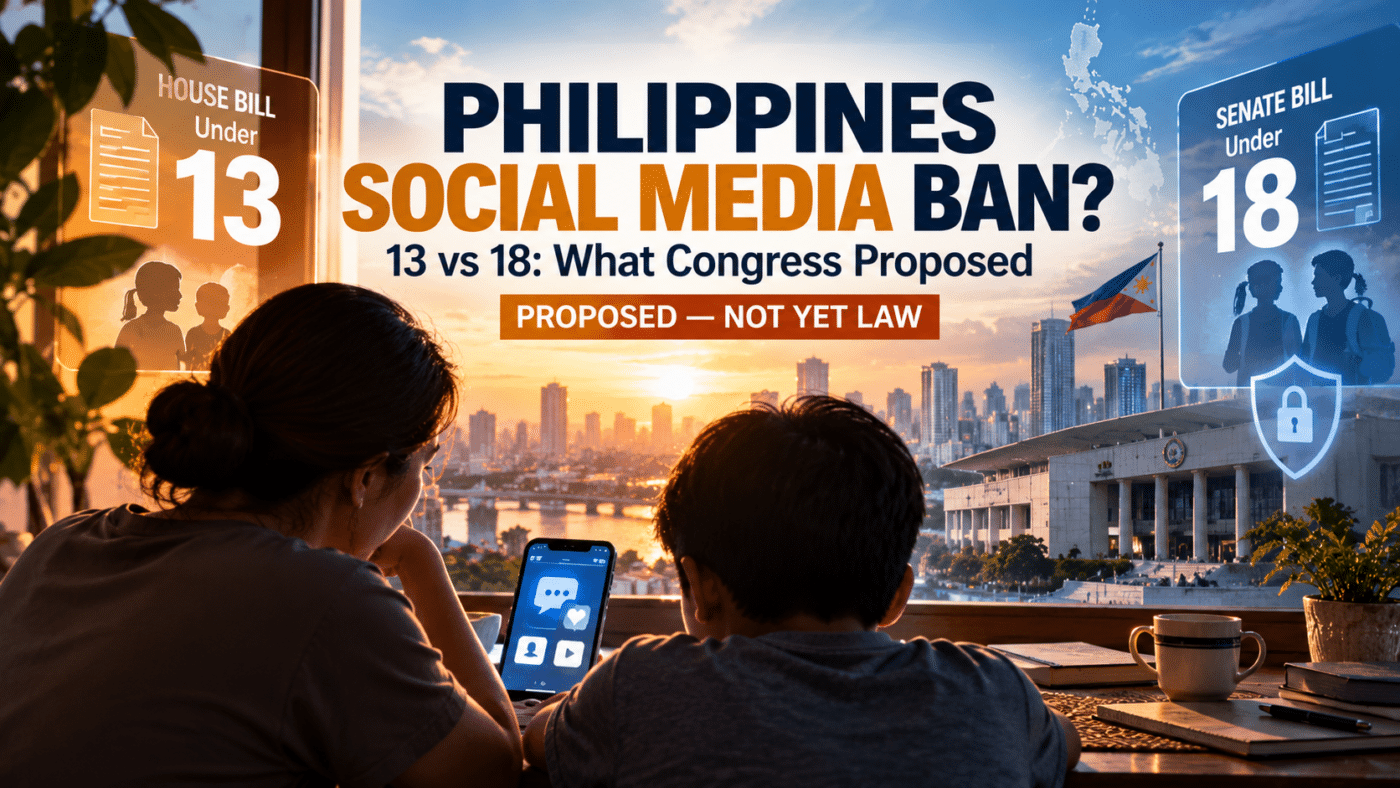
The proposed Philippines social media ban is not yet law. But two versions approved by Congress could significantly change how Filipino children use social media, online gaming platforms, and other digital services.
The House of Representatives approved a measure on October 12 that would prohibit children below 13 from holding accounts on covered platforms while allowing teenagers aged 13–17 access with stronger protections.
The Senate approved a different, more restrictive bill on October 8. The Senate’s SMART KIDS proposal has been reported as restricting users below 18 from services classified as high-risk.
Both measures are intended to protect children. The disagreement is about how far restrictions should go—and whether online safety is better achieved by excluding children from certain platforms or requiring the platforms themselves to become safer.
For parents, teenagers, and technology companies, that distinction matters.
Is social media already banned for children in the Philippines?
No. As of October 17, 2026, neither congressional proposal has become law.
The House’s legislative records show that House Bill No. 11566 was approved on third reading and that a conference committee was requested on October 12.
The Senate approved Senate Bill No. 2424 on third and final reading on October 8, with 16 votes in favor and one against.
The chambers must reconcile their differences before a final bill can proceed through the remaining legislative process.
That means parents should not interpret headlines about congressional approval as an announcement that their children’s accounts must immediately be deleted.
Existing platform rules and Philippine laws concerning privacy, child protection, and illegal online conduct remain applicable.
The proposed restrictions would add new requirements if enacted.
Source: House of Representatives — HB 11566 Legislative Record
What does the House version actually propose?
The House-approved measure, HB 11566, takes a tiered approach based on age.
Rather than treating every person below 18 identically, it distinguishes younger children from adolescents.
Under the House proposal:
| Age group | Proposed treatment |
|---|---|
| Under 13 | No accounts on covered social-media services and specified interactive gaming features |
| Ages 13–17 | Continued access with stronger, age-appropriate privacy and safety restrictions |
| 18 and older | Not subject to the proposal’s special child-account restrictions |
The House measure is not simply a prohibition on young children using Facebook or TikTok.
It also seeks to regulate certain social and interactive features of online gaming platforms.
For teenagers aged 13–17, the text proposes restrictions concerning harmful content, behavioral profiling, targeted recommendations, unnecessary data collection, purchases, livestreaming, and other features considered risky for minors.
A major principle is that safety measures should be built into platforms rather than requiring parents to discover and activate every protection manually.
In practical terms, the House approach attempts to preserve age-appropriate access while placing more responsibility on technology companies.
However, the definitions of covered platforms and features still matter. Not every digital service necessarily falls under the same proposed requirements.
Primary document: HB 11566 — House Third-Reading Text (PDF)
What does the Senate’s SMART KIDS proposal say?
The Senate approved SB 2424, known as the proposed Safe Media Access and Responsible Technology for Kids in Digital Spaces, or SMART KIDS Act.
The measure proposes stronger restrictions on minors’ access to digital services classified as high-risk.
Reports on the final Senate-approved measure describe restrictions affecting children and teenagers below 18.
Covered platforms would be required to implement age-assurance measures and restrict, disable, or remove accounts determined to be used by individuals below the applicable age threshold.
The Senate approach also includes exceptions for certain categories of services, such as email, qualifying private messaging, educational resources, news services, and professional collaboration tools.
This is important: the proposal should not be described as a blanket shutdown of the entire internet for Filipino children.
Why do some reports say 16 instead of 18?
Readers may have noticed conflicting headlines.
Earlier versions and some October 8 reports described a minimum age of 16, with additional safeguards for older teenagers.
Other reports published around the Senate’s final vote describe broader under-18 restrictions, particularly for digital services classified as high-risk.
The changing legislative language and differences in how news organizations summarized the measure have contributed to confusion.
The practical point is that the Senate-approved approach has been reported as substantially stricter than the House’s under-13 rule.
The final authenticated legislative text must determine the precise coverage and age exceptions. This distinction should be checked again when Congress releases a reconciled version.
The real disagreement is more than five years
At first glance, the difference appears to be a simple disagreement between ages 13 and 18.
But the policy disagreement goes deeper.
The House’s approach focuses on allowing teenagers some continued access while requiring companies to design safer online environments.
The Senate’s proposal relies more heavily on preventing minors from holding accounts on services classified as high-risk.
Both approaches involve choices about how risks should be controlled.
Consider a hypothetical 15-year-old Filipino student who uses online communities for school activities, follows educational creators, and communicates with friends.
Under the House’s framework, some covered activities could remain available through an account with stricter protections.
Under the Senate’s stricter high-risk-service framework, the student could lose access to a platform classified as restricted, depending on the final wording and exemptions.
Neither example establishes what the final law will require. It illustrates why lawmakers’ decisions about age, platform classification, and permitted features matter.
Would Filipino teenagers lose access to useful online communities?
That is one of the concerns raised during the debate.
Senator Risa Hontiveros, who voted against the Senate measure, warned that social media also supports young people’s friendships, communication, creative work, and economic activities.
Some teenagers use digital platforms for school communities, small online businesses, content creation, and family communication.
A broader restriction could interfere with legitimate activities alongside harmful ones.
However, supporters of stronger controls argue that children are exposed to online grooming, violent content, exploitation, and digital features designed to encourage prolonged engagement.
The policy question is therefore not simply whether children should be protected.
There is broad agreement that they should.
The harder question is whether the chosen restrictions protect them effectively without unnecessarily limiting legitimate communication, learning, and participation.
The answer will depend partly on how the final law defines high-risk services, exceptions, age assurance, and platform responsibilities.
Will Filipinos be required to upload government IDs?
Not necessarily under every version, and no new nationwide identity-upload requirement has taken effect through these pending bills.
The proposals contain age-assurance requirements, but the methods and privacy safeguards differ.
Some reporting on the Senate proposal describes government-issued identification as a verification mechanism.
The House measure emphasizes reasonable, proportionate, privacy-preserving age assurance rather than establishing a single universal verification method.
Age assurance can involve different technical approaches. Requiring a full identification document is not the only conceivable way to assess a user’s age.
That distinction matters because an online-safety measure could introduce a different privacy risk if platforms collect additional identification information and retain it unnecessarily.
What does the National Privacy Commission say?
On September 23, the National Privacy Commission reminded online platforms that they must already comply with the Data Privacy Act of 2012 when handling children’s personal data.
The Commission called for privacy-preserving age assurance and highlighted the principles of transparency, legitimate purpose, and proportionality.
Those principles are relevant regardless of which proposal Congress eventually adopts.
A child-protection system should not create an unnecessary collection of sensitive information simply to establish a user’s age.
Official source: National Privacy Commission — Digital Platforms and Children’s Data
What happens to online games, Discord, and messaging services?
This is another reason to examine the actual legislation rather than rely only on headlines.
The House proposal includes certain online-gaming features involving communication, sharing, livestreaming, recommendations, and social interaction.
The Senate proposal distinguishes high-risk services from categories of online tools that may be excluded or treated differently.
For example, a game used solely for gameplay is not necessarily equivalent to a social network with public messaging, user-generated content, and algorithmic recommendations.
Similarly, a private messaging application may be treated differently from a public social-media platform.
But whether a particular app is ultimately covered depends on the enacted definitions and any implementing rules.
It would be premature to tell Filipino families that every messaging app, gaming service, or educational community will definitely be banned.
It would be equally premature to promise that every specific platform will be exempt.
How does the Philippine proposal compare with the United States?
The debate is not unique to the Philippines.
In Florida, a law passed in 2024 restricts social-media accounts for children below 14 and requires parental consent for users aged 14–15 on covered platforms.
On October 14, 2026, a federal appeals court allowed Florida to enforce the restrictions after overturning a preliminary injunction.
The legal dispute concerns restrictions on minors and certain social-media platform features.
Florida’s approach makes distinctions between age groups rather than imposing identical requirements on everyone under 18.
However, a U.S. court ruling does not decide whether Philippine legislation would comply with the Philippine Constitution.
The two countries have different laws, constitutional frameworks, and regulatory institutions.
The comparison is useful because policymakers in both countries face a similar challenge:
How can technology companies be required to protect children without imposing restrictions that go further than necessary?
For Filipino-American families following developments in both countries, this is a particularly relevant question.
Source: U.S. Court of Appeals — Florida Social Media Law Decision, October 14, 2026 (PDF)
What should Filipino parents do while Congress decides?
Parents do not need to wait for a new law to improve their children’s online safety.
A practical starting point is to review which services children actually use and what risks exist on each platform.
For example, parents can examine account privacy settings, public messaging, contact requests, location sharing, livestreaming, online purchases, and reporting tools.
Conversations about unwanted contact, suspicious messages, threats, and harmful content are also important.
Children need to know how to seek help when something goes wrong.
These actions do not eliminate every online risk, and parental supervision is not a substitute for platform responsibility.
But they can improve safety without assuming that pending legislation has already taken effect.
Parents should also avoid uploading unnecessary identity documents to unofficial websites claiming to verify compliance with a law that has not yet been enacted.
What happens next?
The immediate legislative question is whether the House and Senate can agree on a common framework.
The most consequential unresolved points include:
- The minimum age for accounts on covered platforms
- Whether all minors or only certain age groups face prohibitions
- Which social-media and online-gaming features are covered
- What forms of age verification are acceptable
- How children’s personal information must be protected
- Which obligations fall on platforms, parents, and regulators
- The final penalties, enforcement procedures, and transition periods
Even after agreement between the chambers, the bill would still need to complete the applicable constitutional and publication processes before enforceable new restrictions could take effect.
For now, the strongest conclusion is also the simplest.
The Philippines is debating major restrictions on children’s social-media use. It has not yet enacted either proposal into law.
PHExpat Bottom Line
The Philippine social media ban debate is fundamentally a choice between different approaches to protecting children online.
The House favors a lower age restriction combined with stronger protections for teenagers.
The Senate has approved a more restrictive framework involving under-18 access to high-risk digital services.
Both seek to address legitimate online dangers.
But legislation should also answer practical questions about education, family communication, children’s privacy, age verification, and how online platforms will be held accountable.
A law’s effectiveness will not be measured only by how many accounts are blocked.
It will also depend on whether the rules meaningfully reduce harm without creating unnecessary new risks.
Protecting children online requires more than choosing an age. It requires clear rules, accountable platforms, enforceable safeguards, and careful attention to children’s rights.
Official records and supporting sources
- House of Representatives — HB 11566 Legislative Status
- House Bill No. 11566 — Third-Reading Text (PDF)
- Philippine News Agency — Debate Over Social Media Restrictions
- National Privacy Commission — Children’s Personal Data
- GMA News — Senate Vote and Under-16 Reporting
- Philippine News Coverage — Senate Under-18 Proposal
- U.S. Eleventh Circuit — Florida Social Media Litigation (PDF)
- PHExpat Editorial Standards & Corrections
Editorial note: This article summarizes the status of proposed legislation and publicly available reports as of October 17, 2026. Reporting on the Senate bill’s age thresholds has differed, and the final authenticated Senate text should be checked before relying on any specific exemption. The article will require updating if Congress reconciles the measures or the President acts on a final bill. This article does not claim that the proposals are already enforceable law.