
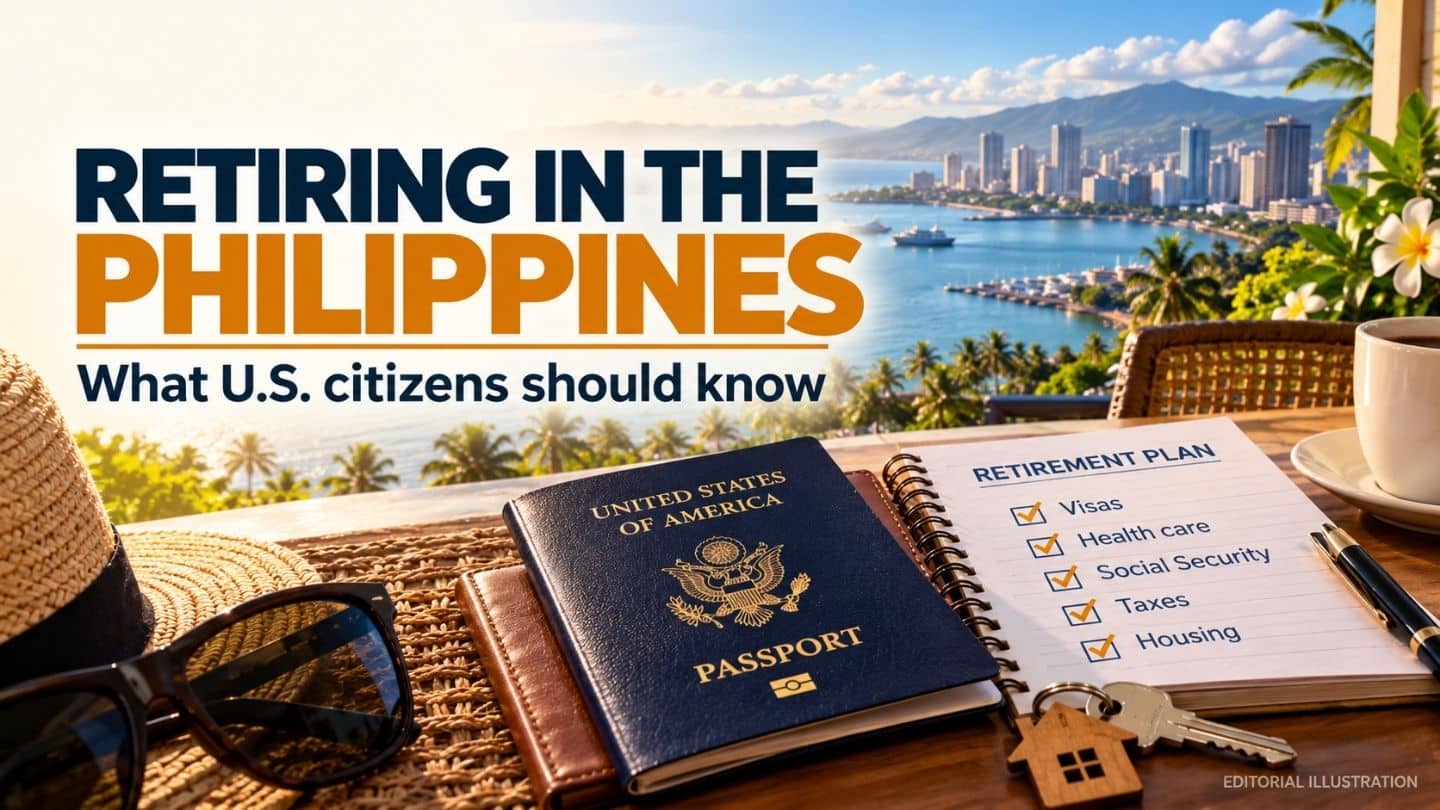
Retiring in the Philippines can be an attractive option for Americans seeking a different lifestyle, reconnecting with family, or making their retirement savings go further.
For Filipino Americans, returning to the country where they grew up may be especially meaningful. Others may be discovering the Philippines for the first time.
But retiring abroad involves more than booking a flight, renting a house, and enjoying a tropical climate.
Questions about immigration, healthcare, Social Security, taxes, property ownership, and everyday expenses can significantly affect the decision.
This PHExpat guide examines seven important considerations using official information from Philippine and U.S. government agencies.
1. Retiring in the Philippines: Which visa do U.S. citizens need?
Before moving, it is important to establish whether you are a Philippine citizen, a former Filipino citizen, or a foreign national without Philippine citizenship.
These distinctions matter because the available immigration options are different.
For Filipino Americans with dual citizenship
A Filipino American who has retained or reacquired Philippine citizenship generally does not need a retirement visa to live in the Philippines as a Philippine citizen.
Republic Act No. 9225 provides a citizenship reacquisition process for qualifying former natural-born Filipinos who became naturalized citizens of another country.
For more information, see PHExpat’s earlier article, Philippine Dual Citizenship for Filipino Americans: 7 Essential Facts.
For former Filipino citizens
Former Filipinos who now hold U.S. citizenship may qualify for the Balikbayan privilege.
The Philippine Embassy in Washington explains that eligible former Filipinos may receive a one-year visa-free stay.
However, the Balikbayan privilege is not equivalent to permanent residence.
Someone intending to retire permanently should examine the appropriate longer-term immigration or citizenship options.
For other U.S. citizens
One option is the Special Resident Retiree’s Visa (SRRV) administered through the Philippine Retirement Authority (PRA).
The PRA’s expanded program permits qualified principal applicants aged 40 and above, subject to applicable conditions.
Different SRRV categories have different financial requirements.
For example, the PRA currently lists the following visa deposits under SRRV Classic:
| Applicant | Required visa deposit |
|---|---|
| Pensioner, age 50+ | US$15,000 |
| Non-pensioner, age 50+ | US$30,000 |
| Pensioner, age 40–49 | US$25,000 |
| Non-pensioner, age 40–49 | US$50,000 |
A pensioner must also satisfy the program’s lifetime-pension requirements.
The SRRV Courtesy category has different eligibility and deposit arrangements, including a category for qualifying former Filipino citizens.
These are program deposits, not estimates of total retirement expenses. Application fees and other requirements also apply.
Official sources:
2. Is retiring in the Philippines actually cheaper?
One reason Americans consider retiring in the Philippines is the possibility of lower everyday expenses.
Housing, local services, and some forms of transportation may cost less than comparable expenses in parts of the United States.
However, affordability varies enormously.
A retiree living near family in a provincial community may have a different budget from someone renting a modern condominium in a major business district.
The lifestyle matters just as much as the location.
Expenses to calculate before relocating
| Expense | What to investigate |
|---|---|
| Housing | Rent, property dues, maintenance and deposits |
| Healthcare | Insurance premiums, consultations, medicines and hospital costs |
| Utilities | Electricity, water, internet and air conditioning |
| Transportation | Vehicle ownership, taxis, fuel and local travel |
| Food | Local groceries versus imported products |
| Immigration | Visa fees, renewal charges or residency-related costs |
| Travel | Flights to visit family in the United States |
| Emergency savings | Medical expenses, unexpected repairs and family emergencies |
Currency movements also matter.
If retirement income arrives in U.S. dollars but expenses are paid in Philippine pesos, exchange-rate changes can affect purchasing power.
For example, a retiree whose expenses are primarily in pesos may have less purchasing power when the dollar weakens against the peso.
There is no single realistic retirement budget that works for everyone.
A useful approach is to rent before buying and track actual spending for several months.
This produces more meaningful information than relying on a social-media claim that everyone can retire comfortably on a particular dollar amount.
3. Can U.S. retirees receive Social Security in the Philippines?
For many Americans, Social Security is central to retirement planning.
The good news is that eligible U.S. citizens can generally continue receiving Social Security retirement benefits while living in the Philippines.
The Social Security Administration (SSA) allows qualified beneficiaries to receive payments in many countries outside the United States.
However, individual eligibility and payment rules still apply.
The SSA provides an official Payments Abroad Screening Tool so beneficiaries can check how overseas residence may affect their benefits.
Social Security retirement benefits are not the same as SSI
This distinction is essential.
Social Security retirement benefits are generally based on an individual’s covered work and eligibility record.
Supplemental Security Income (SSI) is a different, needs-based program with strict U.S.-residence requirements.
Ordinary long-term retirement in the Philippines generally prevents continued SSI eligibility.
Anyone receiving government benefits should confirm precisely which program pays those benefits before relocating.
Other questions to ask
Before moving, verify:
- Whether your specific benefit can continue overseas
- Whether overseas direct deposit arrangements are available
- How to update your address and other details with SSA
- Whether your payments may be affected by changes in personal circumstances
Official sources:
4. Does U.S. Medicare cover healthcare in the Philippines?
This may be the most important financial warning for Americans considering retirement overseas.
Original Medicare generally does not cover medical treatment received in the Philippines.
Medicare explains that healthcare services outside the United States are generally excluded, with limited exceptions.
Those exceptions normally do not make Medicare a practical substitute for comprehensive local health coverage during retirement in the Philippines.
Certain Medicare supplement policies may offer limited international emergency benefits, but such coverage must be checked against the specific policy.
What should retirees consider?
A retiree should examine local or international health insurance, including:
- Hospitalization benefits
- Outpatient consultations
- Emergency treatment
- Coverage of existing medical conditions
- Age-based exclusions or limits
- Prescription medications
- Medical evacuation
- Annual coverage limits and deductibles
Retirees should also examine how maintaining or dropping Medicare enrollment might affect their coverage and future costs if they return to the United States.
This can be particularly important for someone who plans to divide their retirement years between two countries.
Before committing to a location, consider the distance to appropriate hospitals, specialists and emergency medical services.
Official source: Medicare — Coverage Outside the United States
5. Will U.S. citizens still pay taxes after retiring abroad?
Moving permanently to the Philippines does not automatically end U.S. tax obligations.
The Internal Revenue Service states that U.S. citizens are generally subject to U.S. federal income-tax rules on their worldwide income, regardless of where they live.
Whether an individual must file a return or pay a particular amount depends on the applicable rules, filing thresholds and personal circumstances.
Sources of retirement income can include:
- Social Security benefits
- Private pensions
- Retirement-account distributions
- Investment income
- Rental income
- Other domestic or foreign income
Different categories of income may receive different tax treatment.
Does the foreign earned income exclusion cover pensions?
The IRS distinguishes earned income, such as qualifying compensation for services, from unearned income.
Pensions, annuities and Social Security benefits generally do not qualify as foreign earned income for the foreign earned income exclusion.
A retiree should therefore not assume that moving overseas makes pension income exempt from U.S. tax.
What about Philippine bank accounts?
U.S. persons may also have foreign financial-account reporting responsibilities.
For example, the Foreign Bank and Financial Accounts Report, commonly called FBAR, generally applies when the aggregate value of covered foreign financial accounts exceeds US$10,000 at any time during the calendar year.
This is a reporting threshold, not a general tax-free allowance.
Additional reporting requirements may also apply depending on the taxpayer’s assets and circumstances.
The tax treatment of retirement income under Philippine law must also be considered separately.
A qualified tax professional familiar with both U.S. and Philippine rules can help prevent costly mistakes.
Official source: IRS — U.S. Citizens and Resident Aliens Abroad
6. Can a U.S. citizen buy property in the Philippines?
Property ownership is another area where citizenship status makes a major difference.
Under Philippine law, foreign nationals generally cannot own private land in the same way Philippine citizens can.
However, certain exceptions apply.
Philippine dual citizens
Qualified Filipino Americans who have reacquired Philippine citizenship under RA 9225 generally enjoy land-ownership rights associated with Philippine citizenship, subject to applicable property laws.
Former natural-born Filipinos
Even without reacquiring Philippine citizenship, a former natural-born Filipino may qualify to acquire limited areas of private land for specific purposes.
The Philippine Consulate General in Los Angeles explains that special rules apply to former Filipino citizens.
Other foreign nationals
Foreign nationals may be permitted to own certain condominium units, subject to legal restrictions, including limits on foreign ownership within the condominium corporation or project.
Owning a condominium is legally different from owning the underlying land.
Why renting first may be the smarter choice
Even when someone is eligible to buy property, ownership creates responsibilities involving:
- Title verification
- Taxes and registration
- Maintenance
- Homeowners’ or condominium dues
- Property management during overseas travel
- Local environmental and infrastructure risks
Buying a property should not be the first step simply because a location appears inexpensive.
It is generally more prudent to understand the community, infrastructure and legal documentation before making a major financial commitment.
Official source: Philippine Consulate General Los Angeles — Owning Land and Real Estate
7. Should you test retirement in the Philippines before relocating permanently?
Yes. A trial stay is a practical way to evaluate whether the lifestyle actually suits your needs.
The Philippines may feel familiar to Filipino Americans who grew up there.
But visiting relatives for two weeks is different from living there throughout the year.
For Americans who have never lived in the country, the adjustment can be even greater.
Daily realities deserve attention:
Healthcare access
Determine whether suitable clinics, hospitals and specialists are accessible from your intended home.
Weather and infrastructure
Consider seasonal flooding, severe weather, electricity reliability, internet connectivity and transportation.
Family and community
Family support can be valuable, but retirement plans should account for personal independence and changing family circumstances.
Financial arrangements
Check banking access, pension deposits, international transfers and the exchange costs involved in converting dollars into pesos.
Lifestyle expectations
A quiet provincial community may be appealing, but the availability of public services and medical care can differ substantially from major urban areas.
A retirement location should meet actual needs, not just look attractive in vacation photographs.
A practical checklist before moving
Before retiring in the Philippines, consider completing the following preparations:
- Confirm Philippine citizenship or long-term immigration eligibility.
- Check Social Security payments and other retirement income.
- Review Medicare and alternative healthcare coverage.
- Consult a qualified professional about cross-border taxes.
- Evaluate housing and legal property-ownership options.
- Calculate a realistic budget using actual local expenses.
- Complete a trial stay before making irreversible commitments.
None of these steps guarantees a perfect retirement experience, but each can help reduce uncertainty.
PHExpat Bottom Line: Is retiring in the Philippines a good decision?
Retiring in the Philippines can provide meaningful opportunities for U.S. citizens and Filipino Americans.
For some, it means being closer to family, reconnecting with their heritage, or establishing a different lifestyle.
For others, the attraction is the possibility of stretching retirement savings further.
But a lower cost of living is not the same thing as financial security.
Healthcare expenses, immigration rules, taxes, property restrictions, currency fluctuations and personal circumstances can all affect the outcome.
The best retirement destination is not simply the place where life appears cheapest. It is the place where your income, healthcare, legal status and everyday needs can be managed sustainably.
Before moving permanently, confirm the facts with the government agencies responsible for those decisions.
A successful retirement should be based on preparation rather than assumptions.
Official sources and further reading
- Philippine Retirement Authority — Special Resident Retiree’s Visa
- Philippine Embassy Washington — Visa and Balikbayan Information
- Social Security Administration — Payments Abroad
- Medicare — Travel Outside the United States
- Internal Revenue Service — U.S. Citizens Abroad
- Philippine Consulate General Los Angeles — Property Ownership
- PHExpat Editorial Standards & Corrections
Editorial note: This article provides general information from publicly available government sources reviewed on October 1, 2026. Immigration rules, visa deposits, insurance arrangements and tax requirements can change. It is not individualized immigration, financial, medical or tax advice.