
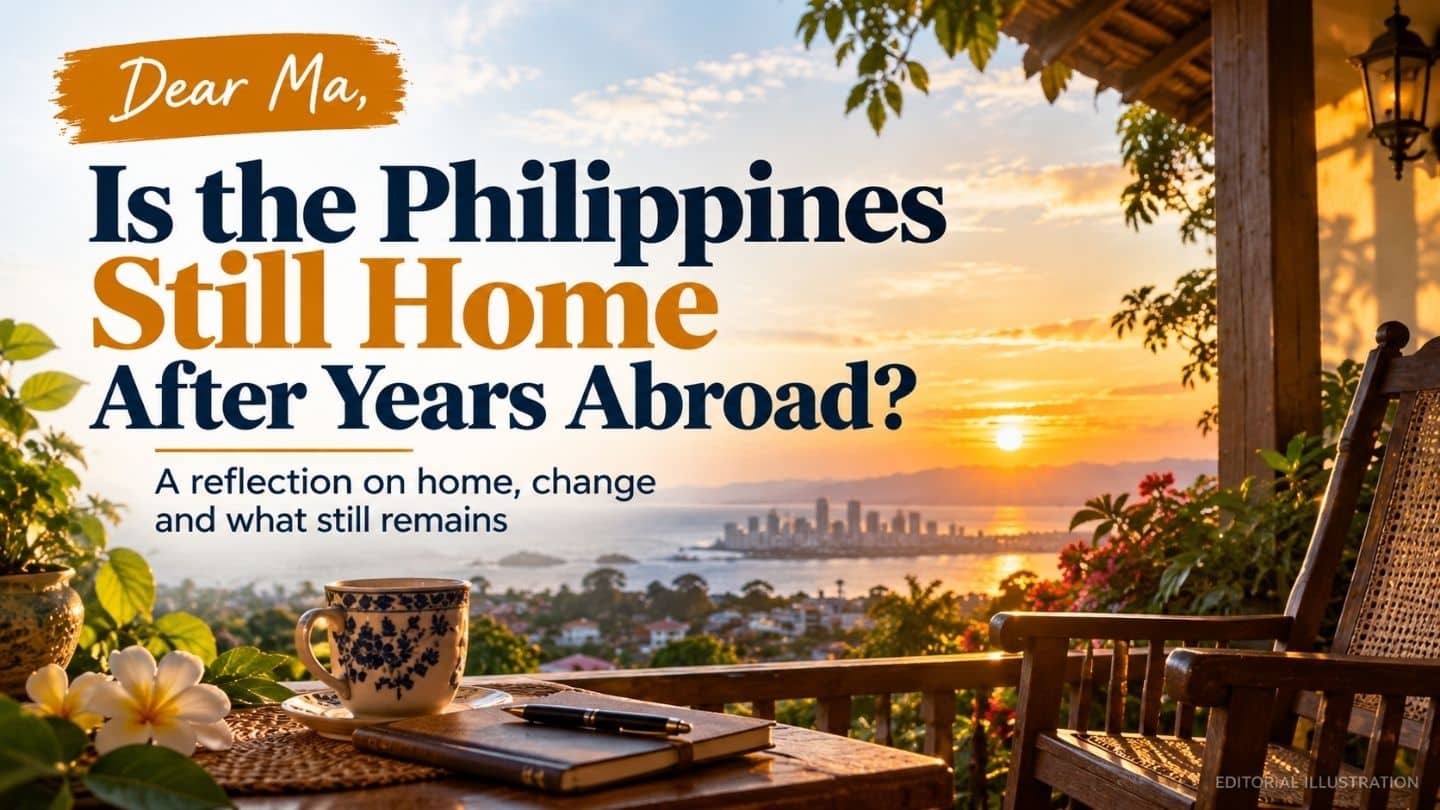
Ma,
I’ve spent years living outside the Philippines, and there’s a question I’ve been thinking about.
Is the Philippines still home after years abroad?
It sounds like a simple question, doesn’t it?
After all, I am Filipino. The Philippines is where I came from. It’s the country that shaped my identity, my understanding of family, and the way I see the world.
But the longer someone lives away, the more complicated the meaning of home can become.
Sometimes I wonder whether home is simply the country where we were born, the place where we currently live, or somewhere connected to the people we love.
And Ma, when some of those people are no longer with us, the answer becomes even harder.
Ma, leaving home doesn’t mean forgetting it
For many Filipinos, leaving the Philippines is not necessarily about wanting to leave everything behind.
Sometimes it’s about finding work, pursuing opportunities, supporting family, or building a future that might otherwise be difficult to achieve.
We leave because we hope life can become better.
But something interesting happens when we spend years living in another country.
We gradually build routines.
We become familiar with different ways of doing things. We learn to navigate other cultures, expectations, and responsibilities.
And eventually, the country where we once felt like visitors can begin to feel familiar.
Yet that doesn’t automatically make us feel any less Filipino.
Maybe that’s one of the strange realities of living abroad.
We can become accustomed to another country without ever completely leaving our own behind.
The Philippines keeps changing while we’re away
Ma, there’s something else I’ve been thinking about.
The Philippines does not stop changing just because we are no longer living there.
New buildings appear. Communities grow. Familiar places change. Government policies come and go.
And the people we left behind continue living their lives.
Sometimes, when we imagine returning, we picture the Philippines as we remember it.
But memories can preserve places in a way that real life cannot.
The country continues moving forward, whether we are there to witness those changes or not.
I wonder how many Filipinos experience this when returning after years overseas.
Perhaps a familiar street no longer looks quite the same.
Perhaps friends have moved away.
Perhaps the community they remember has grown into something different.
And perhaps they themselves have changed more than they realize.
That’s why returning home may not always mean returning to the life we once knew.
Sometimes, it means learning how to belong again.
Ma, I wonder what coming home would feel like without you
There’s another part of this question that isn’t really about geography.
It’s about people.
When we talk about home, we often imagine houses, neighborhoods, hometowns, and countries.
But home can also mean the people who made those places meaningful.
The people we looked forward to seeing.
The people we wanted to share our experiences with.
The people whose presence made an ordinary place feel different.
Ma, you’re no longer here, and that’s something no country, city, or new beginning can change.
I can return to the Philippines.
I can visit familiar places.
I can reconnect with the life I left behind.
But I cannot return to a time when everyone I loved was still there.
Maybe that’s one reason home can feel different as we grow older.
Sometimes we don’t just miss a place. We miss the people who made that place feel like home.
And those are two different kinds of longing.
Living abroad changes how we see the Philippines
Ma, I also think that distance can change our perspective.
When we live in one place for many years, we become accustomed to its systems, its strengths, and its problems.
Living somewhere else gives us another point of comparison.
We begin noticing differences in public services, infrastructure, government processes, employment opportunities, and everyday life.
That does not mean one country is perfect and another is hopeless.
Every country has challenges.
But exposure to different experiences can encourage us to question things we once accepted without much thought.
It can also help us appreciate things about the Philippines that we previously overlooked.
And perhaps that’s one reason I’ve become interested in understanding what happens back home.
I don’t want to look at the Philippines only through political arguments, social-media posts, or headlines designed to make people angry.
I want to understand what is actually happening.
What is working?
What needs improvement?
And what do government decisions mean for ordinary Filipinos?
Loving a country should leave room to recognize its strengths and question its shortcomings.
We should be able to celebrate progress without ignoring problems.
And we should be able to criticize decisions without losing our affection for the country itself.
That’s the perspective I want to bring to PHExpat.
What if I return to the Philippines for good?
Ma, I’ve wondered about that possibility too.
What happens when someone who has spent years abroad decides it’s finally time to return?
Would life feel easier because everything is familiar?
Or would there be another adjustment, just as there was when they first moved overseas?
Some returning Filipinos may be excited to reconnect with family, community, language, and culture.
Others may find that they have become accustomed to a different lifestyle.
And some may experience both feelings.
The decision is not always simple.
There are practical questions about employment, healthcare, financial security, and where to settle.
There are also personal questions.
Would I be comfortable starting another chapter of life in the Philippines?
Would I miss the routines I’ve built overseas?
Would I feel at home immediately?
Or would I need time to rediscover what belonging means?
I don’t have all those answers.
And perhaps I don’t need to have them today.
Maybe home doesn’t have to mean only one place
For Filipinos who have built lives overseas, the idea of home can become complicated.
A Filipino living in California may have family, work, and a community in the United States while still feeling deeply connected to the Philippines.
An overseas worker in the Middle East may spend years building a life abroad while continuing to think of the Philippines as home.
A Filipino who eventually returns permanently may discover that belonging is something that needs to be rebuilt, not simply resumed.
Each experience is different.
Maybe home isn’t always a single location.
Maybe it is connected to identity, memories, relationships, and the life we continue creating.
Living overseas doesn’t erase where we came from.
And returning to the Philippines doesn’t erase the years we spent elsewhere.
Both experiences become part of who we are.
Ma, I think the Philippines will always be part of home
I still don’t have a perfect answer to the question I started with.
Is the Philippines still home after years abroad?
I think it can be.
Not necessarily because everything remains familiar.
Not because the country is perfect.
And not because returning would automatically restore the life we once knew.
But because our connection to home can survive distance, change, and time.
The Philippines may continue changing.
I may continue changing too.
The future might take me somewhere new, or perhaps one day bring me back permanently.
Whatever happens, I don’t think the years I’ve spent overseas can erase the country that remains part of my story.
And Ma, even though you’re no longer here, you remain part of that story too.
Maybe that’s something I’ve come to understand about home.
Home isn’t always a place we can return to exactly as we remember it.
Sometimes it’s a connection we continue carrying, even as life moves forward.
And perhaps that’s enough.
Until our next conversation, Ma.
About Dear Ma: This is a personal essay series on PHExpat, written as reflections addressed to my late mother. These essays express personal thoughts and questions, not reported conversations or statements attributed to her.